
Installation · 5 min
Uncovering the Myths and Facts to Choose the Best Salt Chlorinator

Salt chlorination has become a popular, efficient alternative to traditional chemical chlorine disinfection in pools. Its benefits are many: greater comfort for bathers, less maintenance and reduced environmental impact. However, it is natural to have questions before making the switch to this system.
At BSPOOL, we are water treatment experts and we know that choosing the best salt chlorinator for your pool is an important decision. That is why we have gathered the most frequently asked questions about this system to help you better understand this technology and clear up any doubts.
1. How exactly does a salt chlorinator work?
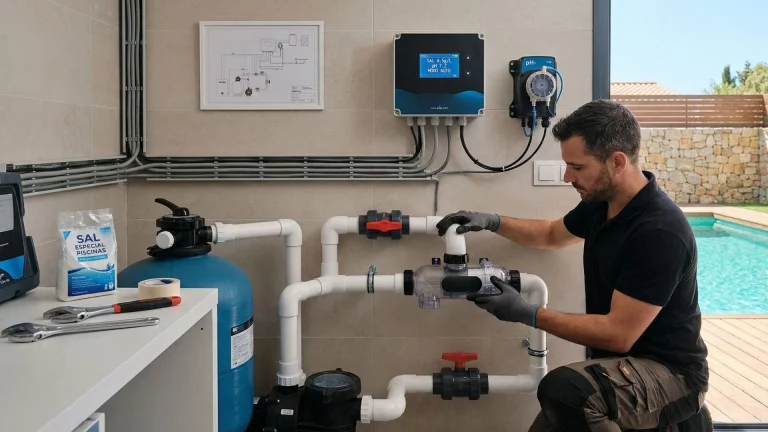
The salt chlorination system is surprisingly simple and natural. Instead of adding chemical chlorine directly to the pool water, a small amount of common salt (sodium chloride, NaCl) is dissolved in the water. This salt water passes through an electrolytic cell, which is part of the salt chlorinator. When an electric current is applied through the cell, an electrolysis process takes place that turns the sodium chloride into sodium hypochlorite (HClO), a form of active chlorine that disinfects the water. Once the sodium hypochlorite has done its job, it turns back into salt, repeating the cycle. It is a closed, regenerative system.
2. Is it true that my pool water will taste salty or be like the sea?
Not at all! This is one of the most common questions and one of the biggest myths. The salt concentration needed in a salt chlorination pool is significantly lower than that of seawater. Normally, 4 to 6 grams of salt per litre of water (g/L) are required, roughly the salinity of a human tear. This means the water is barely perceptible to taste and does not irritate the eyes or skin. In fact, many users report a much softer, more pleasant feel than with traditional chemical chlorine.
3. Do I still need to add chlorine or chemicals?
The main advantage of the salt chlorinator is that it generates chlorine automatically from salt, so the need to add chemical chlorine by hand almost disappears. However, it is important to note that, depending on factors such as bather load, water temperature or weather events, a shock chlorination may occasionally be needed if a specific water problem arises. The system takes care of regular disinfection, but good control of water parameters is still crucial.
4. What maintenance does a salt chlorination system require?
Maintaining a salt chlorination system is generally simpler than maintaining a conventional pool. The main tasks include:
- Checking the salt level: Although the salt is not consumed, a small amount can be lost through filter backwashing, splashing or heavy rain. It is advisable to measure the salt level regularly and add more if needed.
- Cleaning the electrolytic cell: Over time, the cell can build up limescale deposits. Especially in hard water areas, occasional manual maintenance with a mild acid solution may be needed.
- pH control: Although the chlorinator generates chlorine, the water’s pH can tend to rise. That is why it is essential to monitor and adjust pH regularly to ensure maximum disinfectant effectiveness and bather comfort. Many salt chlorinator models already include pH regulators to automate this task.
5. Is a salt chlorinator suitable for all types of pools?
Salt chlorinators are an excellent option for the vast majority of pools, both private and community pools. They are compatible with different types of lining (mosaic tiles, liner, polyester, etc.). However, it is important to properly insulate the pool’s metal parts to avoid possible corrosion problems.
6. How much does it cost to install a salt chlorinator and what is its energy consumption?
The initial cost of installing a salt chlorinator may be higher than that of a traditional system. However, this investment pays for itself in the medium and long term thanks to savings on chemicals and less time spent on maintenance. The energy consumption of a salt chlorinator is relatively low, comparable to that of a low-energy light bulb, as it only needs electricity for the electrolysis process. The best salt chlorinator in terms of energy efficiency will be one with an optimised design (especially if it uses modern technology such as switched-mode power supplies) and, in some cases, features such as automatic regulation of chlorine production according to demand.
7. How can I choose the best salt chlorinator for my pool?
Choosing the best salt chlorinator depends on several key factors:
- Pool volume: The chlorinator must have the right chlorine production capacity for the size of your pool.
- Pool use: If the pool is used intensively, you will need a chlorinator with greater capacity.
- Water quality: In areas with very hard water, consider models with more efficient self-cleaning systems.
- Climate: In areas with very hot summers, it is always important to slightly oversize the chlorinator’s production capacity to offset the faster breakdown of active chlorine.
- Additional features: Some salt chlorinators include pH control, ORP control (redox potential, to measure the water’s level of disinfection), automatic dosing systems and smart connectivity for remote control. These features can offer greater convenience and more precise control.
Ready to take the step towards more efficient, convenient disinfection?
We hope these answers have cleared up your most common questions about salt chlorination. At BSPOOL we are committed to offering you the best solutions for caring for your pool.
We invite you to explore our full range of salt chlorinators. You will find everything from basic models to the most advanced ones with integrated pH regulators and smart control, so you can find the best salt chlorinator for your needs.
-
 4 min read
-
 5 min read
-
 3 min read
-
 2 min read
Installation
How to install a BSPOOL salt chlorination system
-
 2 min read
-
 3 min read
Installation
How to choose the best salt chlorinator
Got a question that none of our articles answers?
Our technical team replies in writing within 24 business hours, and the official service network covers all of Spain.