
SAFETY AND MAINTENANCE · 4 min
Safety in salt chlorination: how to prevent gas build-up and chemical imbalances with automatic control
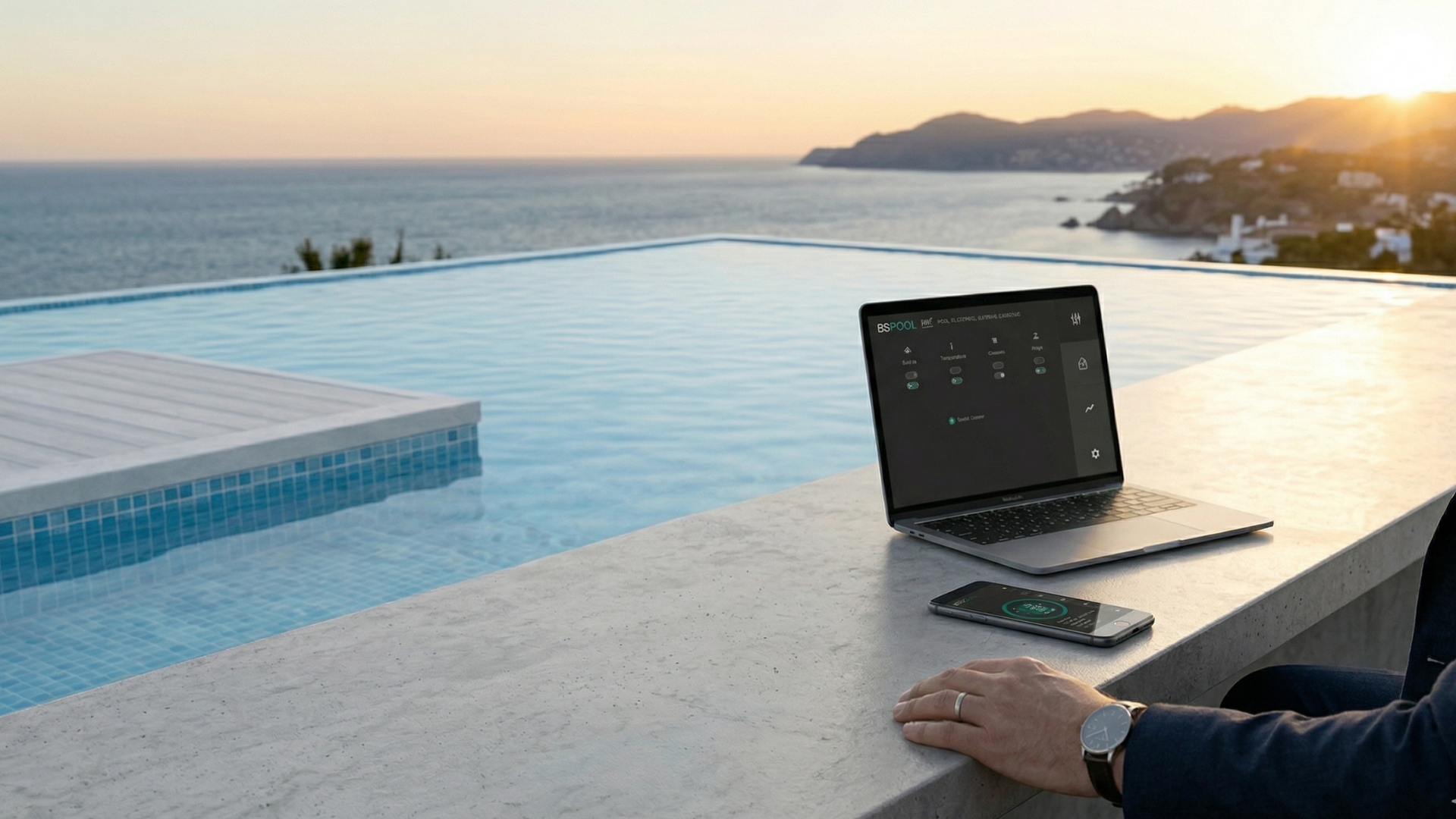
At the BSPool technical service we often see salt chlorination safety associated solely with not having to handle drums of sodium hypochlorite or chlorine tablets day to day. However, in our field inspections we find that an electrolysis unit without active protection elements can cause serious problems in the plant room: from dangerous build-up of chlorine gas and overpressure due to lack of recirculation, to ongoing chemical imbalances caused by poorly calibrated probes.
1. On-site generation vs. plant room risks
The great technical advantage of salt electrolysis lies in producing hypochlorous acid (the active disinfectant) directly in the pipework through electrolytic dissociation of sodium chloride diluted at safe concentrations of 3 to 5 g/l, eliminating the need to store concentrated oxidising products at home.
However, the electrochemical process naturally generates two by-products in the titanium cell: chlorine gas and hydrogen. As long as water flows at an adequate rate (usually above 5 to 7 m³/h depending on pipe diameter), these gases dissolve instantly and enter the pool perfectly mixed. The mechanical risk arises when the recirculation pump stops or loses prime while the cell is still receiving power: the gases build up in the sealed chamber, raising the internal pressure and compromising the structural integrity of the electrode housing and the PVC pipework.
2. Common failure factors and risks in unattended systems
The mechanical and chemical safety of the system depends on three critical factors that should not be left to manual estimation:
- No water flow through the cell: If the filtration motor jams or the timer stops without cutting power to the chlorinator, the build-up of hydrogen and chlorine gas creates an air pocket that overheats the electrodes and can physically rupture the cell housing through overpressure.
- Drift and wear of analytical probes: A worn or uncalibrated pH electrode that reads higher than the actual value will cause continuous injection of pH reducer, driving the value below 6.8 and producing highly acidic water that is corrosive to metals and irritating to bathers.
- Overdosing due to lack of redox (ORP) control: Keeping a chlorinator running at a fixed percentage without modulation by oxidation potential produces free chlorine peaks above 4-5 ppm during periods of low use, damaging seals, solar covers and metal pool components.
3. Active safety protocol: automation and protection of the electronics
To turn the installation into an autonomous ecosystem free from operational failures, residential systems and the Touch EVO range integrate specific safety components:
- Flow switch (magnetic or mechanical): Immediately cuts the power supply to the titanium cells as soon as the flow drops below the minimum safety threshold or an air pocket is detected, preventing trapped gas from forming.
- Proportional dosing analytical kits (Kit Auto Touch / Kit Advanced): Fitted with high-precision pH probes and redox electrodes, they adjust pH reducer injection and stop electrolysis at the exact moment the target value (setpoint) is reached, preventing over-chlorination.
- Monitoring and critical alarms with BSLINK: Transmits sensor status to your smartphone in real time, alerting you instantly to flow failures, depleted reagents or temperature deviations before they affect water quality or the unit’s electronics.
-
 3 min read
SAFETY AND MAINTENANCE
Salt chlorination and safety: the smart technology that guarantees your peace of mind
-
 3 min read
-
 3 min read
Water quality and maintenance
Green water and extreme heat: how to recalibrate salt chlorination and filtration cycles during heatwaves
-
 3 min read
Water quality and wellbeing
Filter system and salt chlorinator: technical parameters to turn your pool into a chloramine-free spa
-
 3 min read
Water quality and wellbeing
Salt electrolysis and dermatitis: how to eliminate chloramines and protect sensitive skin
-
 4 min read
Got a question that none of our articles answers?
Our technical team replies in writing within 24 business hours, and the official service network covers all of Spain.