
Product · 4 min
How to choose the ideal filtration pump and salt chlorinator for your pool
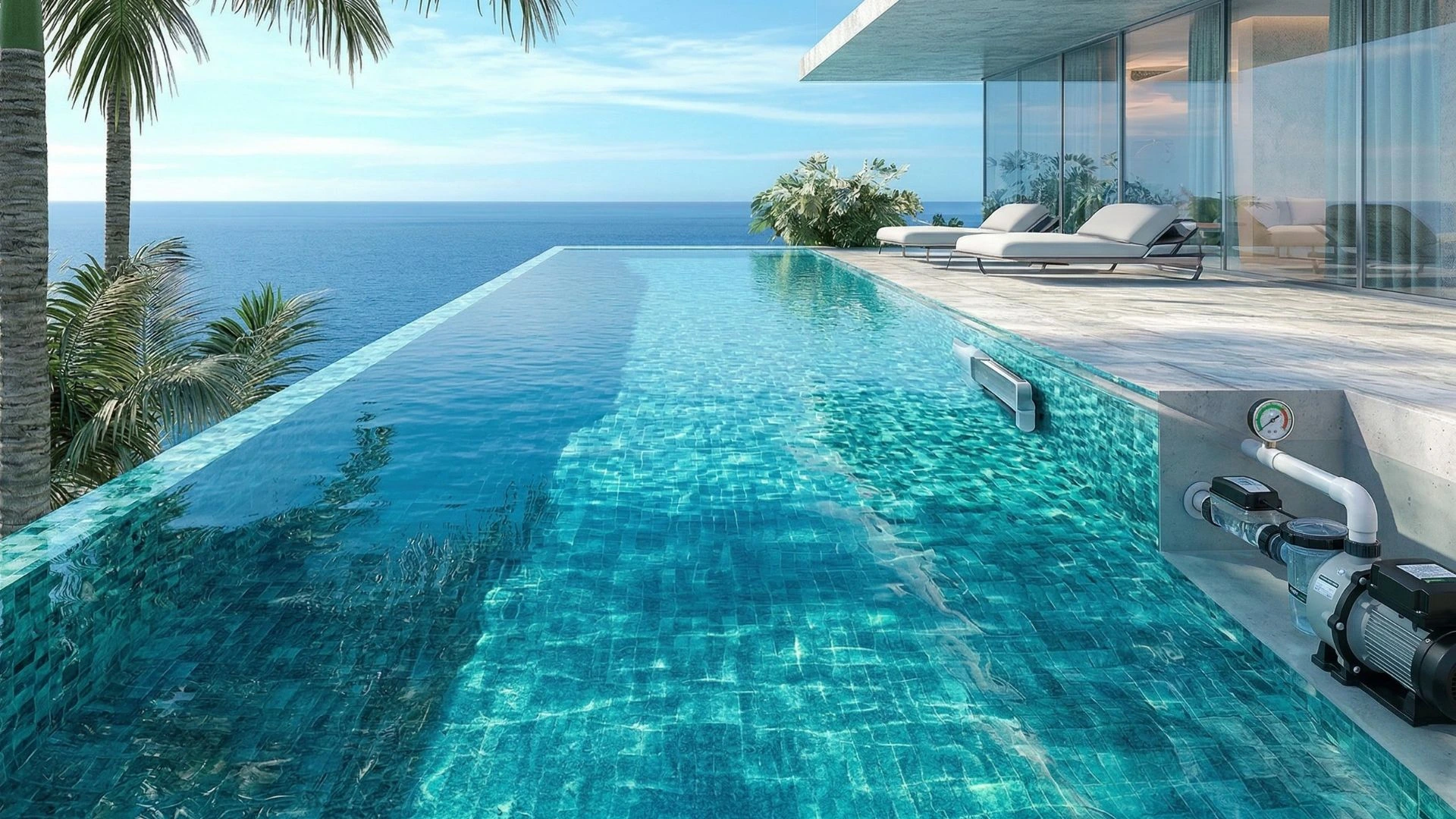
By the end of this article, you will understand why the filtration pump is the “vital partner” of your salt chlorinator. You will learn how to configure a system that not only disinfects, but also maximises energy efficiency and protects the electronics of your BSPOOL unit, ensuring a lasting investment and hospital-grade water quality.
To maximise the performance of a salt chlorinator, the best option is a variable-speed pump made with AISI 316 stainless steel components. This type of pump allows constant, slow flows that optimise chlorine production in the titanium cell, improve filtration quality and reduce power consumption by up to 80%.
Contents:
- Why does a salt chlorinator need a specific pump?
- The relationship between flow rate and the electrolysis cell
- Variable-speed or single-speed pump?
- Corrosion resistance: the AISI 316 standard
- Balance is key: avoid oversizing
- Conclusion: BSPOOL technology for perfect water
Why does a salt chlorinator need a specific pump?
Installing a salt electrolysis system is undoubtedly one of the smartest decisions for maintaining your pool. However, the system’s efficiency does not depend only on the disinfection unit; the filtration pump must be up to the task.
At BSPOOL, as manufacturers in Barcelona with decades of experience in industrial electronics, we know that choosing the wrong pump can compromise even the best chlorinator. It is not just about moving water, but moving it intelligently so that chemistry and physics work in harmony.
The relationship between flow rate and the electrolysis cell
The heart of pool salt chlorinators is the electrolytic cell. For the process of turning salt into natural chlorine to be efficient, the cell needs a constant, well-calibrated water flow.
- Risks of insufficient flow: If the water circulates too slowly, the chlorine produced builds up excessively inside the cell. This raises the temperature, which can degrade the titanium coatings and drastically shorten their lifespan.
- Risks of excessive flow: If the water passes through at very high speed, the efficiency of the reading sensors (such as pH or Redox) is compromised, as they do not have enough contact time to give an accurate reading.
A balanced flow is the secret to BSPOOL systems working with surgical precision.
Variable-speed or single-speed pump?
If you have already opted for the innovation of a salt chlorinator, our technical recommendation is clear: choose a variable-speed pump.
These are its strategic advantages:
- Massive energy savings: By running at low speed for longer periods, power consumption plummets compared with traditional pumps.
- Superior filtration quality: When water passes slowly through the filter media (sand or glass), small particles are retained much more effectively.
- Synergy with BSPOOL: Our systems are designed to perform at their best with constant, slow flows, which optimises chlorine production and keeps the water crystal clear effortlessly.
Corrosion resistance
We often hear that the salinity of a pool treated with electrolysis is minimal, similar to a human tear. That is true, but we should not let our guard down. Even this low salt concentration creates a more demanding environment than traditional chemical chlorine.
To protect your investment, make sure your pump includes:
- High-end mechanical seal: It should be made of resistant materials such as AISI 316 stainless steel.
- Salt water certification: Not all pumps are compatible; look for the manufacturer’s explicit specification.
- Advanced thermal protection: Essential to prevent the motor from overheating during peak operation in midsummer.
Balance is key
In the hydraulic design of a pool, “more power” rarely means “a better result”. An oversized pump can be counterproductive.
If the pump is too powerful for your filter, the water will enter with such force that it displaces the sand or glass, creating “preferential channels”. The result? The water passes through without being properly filtered and returns to the pool with impurities. For your salt chlorinator to work in an optimal environment, the pressure must always stay in the green zone of the pressure gauge.
Conclusion
Choosing the right pump is not just a matter of moving water; it is a strategic decision that protects your wallet through energy savings and safeguards the lifespan of your BSPOOL disinfection system.
The combination of an efficient salt chlorinator and a well-calibrated variable-speed pump is the gold standard of the “Smart Pool”. You will not only get healthier, more sustainable water, but also enjoy the peace of mind of a robust, automated system.
Need help configuring the perfect system for your home?
At BSPOOL (BSV Electronic), we design technology in Barcelona for the world. If you have questions about which pump model best suits your unit, contact our experts. We will be happy to help you design the pool of the future.
-
 3 min read
-
 2 min read
Product
Pool process automation
-
 3 min read
Product
How to light your pool?
-
 2 min read
-
 3 min read
SAFETY AND MAINTENANCE
Salt chlorination and safety: the smart technology that guarantees your peace of mind
-
 3 min read
Got a question that none of our articles answers?
Our technical team replies in writing within 24 business hours, and the official service network covers all of Spain.