
Water quality and maintenance · 3 min
Green water and extreme heat: how to recalibrate salt chlorination and filtration cycles during heatwaves
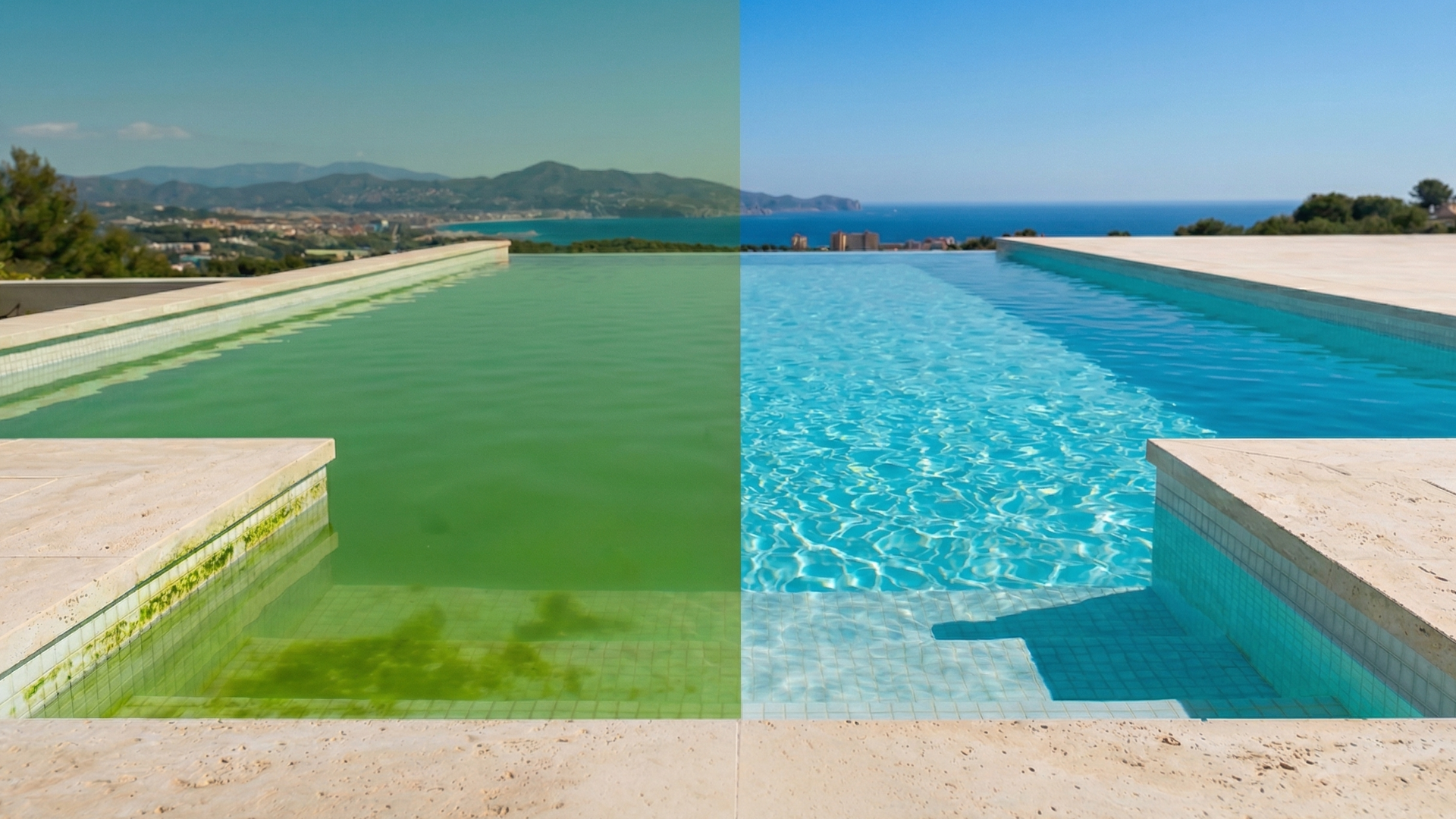
At the BSPool technical service, every summer we see the same critical scenario during heatwaves: pools that wake up cloudy or with greenish walls despite having the salt chlorinator switched on. The user’s usual reaction is to rush out and buy algaecides or granular shock chlorine; however, in our field inspections we find that the problem is not an equipment fault, but a thermal mismatch in filtration schedules and a loss of disinfecting power caused by rising pH.
1. Chlorine degradation and microbial behaviour above 28 °C
The traditional formula for calculating summer filtration (filtration hours = water temperature divided by 2) no longer holds once the thermometer exceeds 28 °C or 30 °C in the pool. At high temperatures, oxygen solubility drops sharply and the reproductive cycle of algae spores accelerates exponentially.
Direct sunlight adds to this biological factor: ultraviolet rays destroy free chlorine at the surface within hours if the water stays still. If the unit does not produce disinfectant continuously during the peak sunlight hours, the rate of evaporation and degradation far exceeds the water’s residual response capacity.
2. Critical factors that turn water green during extreme heat
Summer algae growth is caused by three technical imbalances that cancel out the oxidising capacity of salt electrolysis:
- Out-of-sync night-time filtration: Scheduling the pump exclusively at night to save energy leaves the pool without active chlorine replenishment precisely when sunlight is strongest and algae are photosynthesising (between 12:00 and 18:00).
- Chlorine inactivated by alkaline pH (> 7.6): Sunlight, sweat and evaporation naturally raise pH. When pH exceeds 7.6, more than 80% of the chlorine generated by salt electrolysis is locked up as hypochlorite ions, losing its germicidal and oxidising capacity.
- Cyanuric acid saturation: Occasional use of traditional stabilised chemical chlorine leaves residual cyanuric acid. Concentrations above 50 ppm chemically block the chlorine generated by the electrodes, making it ineffective against organic matter.
3. Technical shock protocol: readjusting and automating the salt chlorinator
To recover green water without destabilising the water balance or forcing drain-downs due to excess chemicals, the system should be configured according to the following protocol:
- Extend the recirculation cycle: Increase running time to 10 to 12 continuous hours, concentrating the main block during the hours of strongest sunshine.
- Activate “Boost” or “Shock” mode (100% output): On ranges such as EvoBasic or EvoMg, activate continuous production for 24 hours so the titanium cells generate enough oxidising concentration to burn off organic matter without producing chemical residues.
- Strict pH stabilisation (7.2 – 7.4): Calibrate the reading probe and let the dosing pump keep the water at 7.2, ensuring 100% reactivity of the free hypochlorous acid.
- Remote supervision with BSLINK: Monitor ORP (redox potential) and temperature values in real time from your smartphone to proactively increase electrolysis output before the water visibly starts to deteriorate.
-
 3 min read
SAFETY AND MAINTENANCE
Salt chlorination and safety: the smart technology that guarantees your peace of mind
-
 3 min read
-
 4 min read
-
 3 min read
Water quality and wellbeing
Filter system and salt chlorinator: technical parameters to turn your pool into a chloramine-free spa
-
 3 min read
Water quality and wellbeing
Salt electrolysis and dermatitis: how to eliminate chloramines and protect sensitive skin
-
 4 min read
Got a question that none of our articles answers?
Our technical team replies in writing within 24 business hours, and the official service network covers all of Spain.