
Water quality · 3 min
Does your pool have the right amount of salt?

For a salt chlorination pool to carry out the chlorine generation process correctly, we need to take into account how much salt is needed for each installation.
Many people believe it is enough to add salt to the water when the salt chlorinator is first started up. However, we need to set aside this false belief, because over time the salt concentration in the pool decreases due to processes such as evaporation, filter backwashing and water leaving the pool through use.
Likewise, this does not mean you have to keep adding salt to the pool, as you could exceed the amount the pool should have. What is important is to measure the pool’s salt levels from time to time to keep this under control. Otherwise, we could find ourselves in two possible scenarios:
- If the level is too high, metal elements and accessories in contact with the water can corrode, the water can start to taste very salty and can look cloudy.
- If the salt levels are too low, we can have problems generating natural chlorine.
How to calculate the cubic metres of your pool
For a rectangular pool, you need to take into account the dimensions (length and width) of the surface of the pool and the average depth to calculate its cubic metres.
If, on the other hand, it is a round pool, to calculate the cubic metres you need to multiply the diameter of the pool by the diameter by the average depth by a coefficient of 0.78.
How to carry out a salinity test
The salt concentration in a pool should be between 4 and 5 grams per litre of water, so you would need to add around 4 to 5 kilos of salt per m3 of the pool. These are salt levels far below the amount of salt in a human tear. There are also salt chlorination units that work with just 1 gram per litre, known as Low Salinity units, available for residential pools.
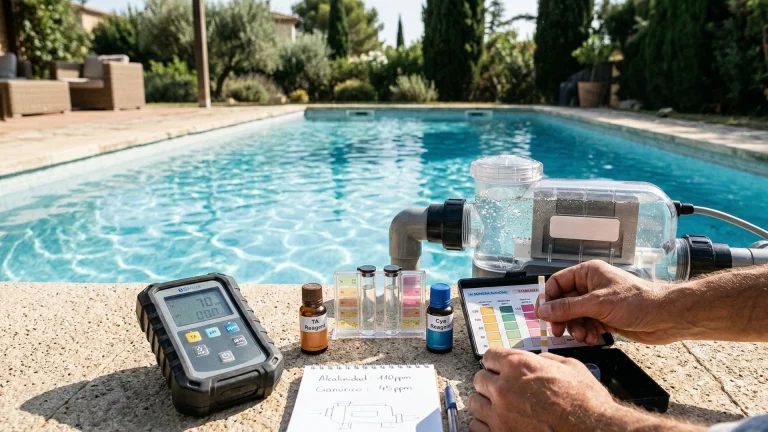
To carry out the salinity test, BSPool has a range of dosing products and related kits that include digital salt meters, such as the HI98302 TDS, which can determine whether the pool’s salt levels are right or not.
We also recommend checking the salt levels in the water at least once a month, whether or not the pool is in daily use. This way we make sure the levels are right and avoid the possible problems mentioned above.
If you have any further questions about the ideal amount of salt for your pool, we have a technical service network that will help you with everything you need.
-
 5 min read
-
 3 min read
Water quality
The importance of pH in salt chlorination pools
-
 2 min read
Water quality
Why does white foam appear in pool water?
-
 2 min read
Water quality
Pool pH control with advanced BSPool technology
-
 2 min read
Water quality
Regulate your pool’s pH
-
 3 min read
Water quality
Why does your pool turn green?
Got a question that none of our articles answers?
Our technical team replies in writing within 24 business hours, and the official service network covers all of Spain.