
Water quality · 5 min
Beyond pool pH: the key role of stabiliser and alkalinity in water chemistry
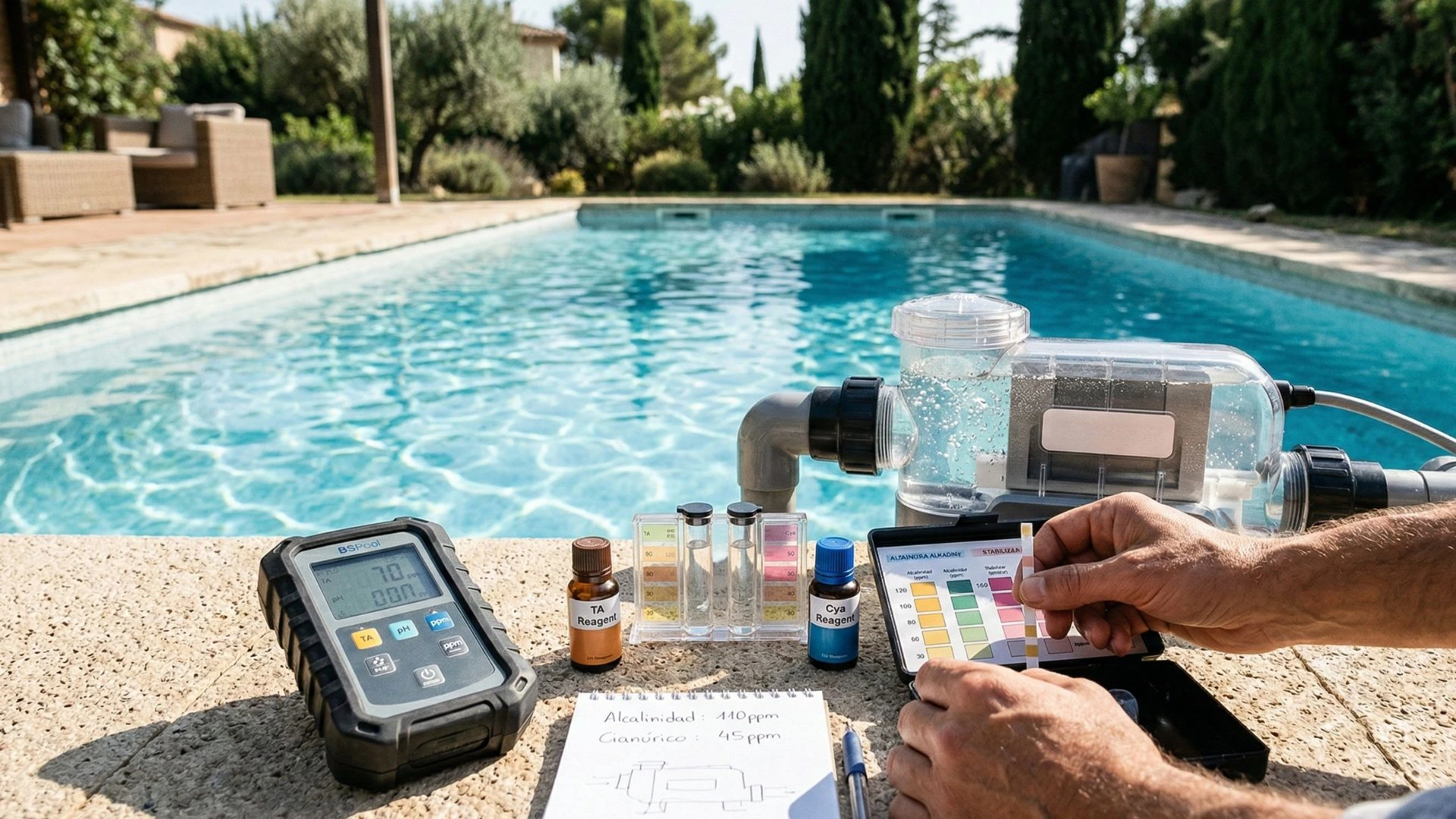
To keep your pool pH perfect, it is vital to stabilise alkalinity (80-120 ppm) and cyanuric acid (30-50 ppm) first. Without these values, the chlorine generated by electrolysis is destroyed by UV rays in less than two hours or causes scaling that damages the titanium electrodes. BSPOOL technology automates this control to ensure efficiency and water health.
In this article you will learn that pool pH is not an isolated value, but the result of a balance between alkalinity and stabiliser. By the end, you will be able to diagnose why your salt electrolysis unit uses more energy than necessary and how to protect its titanium cells to save costs in the long term.
Contents
- Why doesn’t pool pH stabilise on its own?
- Total alkalinity: the protective “shield” of your pH
- Cyanuric acid: maximising the efficiency of “pure” chlorine
- Impact on the lifespan of your BSPOOL unit
- Chemical balance as a pillar of water sustainability
- Benefits of advanced automation
- Conclusion and next steps
Many pool owners face the same frustrating cycle: they measure the pool pH, add product to raise the pool pH or lower it, and two days later the values are out of control again. This instability not only ruins the swimming experience, but also forces your salt electrolysis equipment to work at its limit, shortening its lifespan and increasing power consumption.
At BSPOOL, we understand that water chemistry is a precision science. It is not just about adding salt; it is about creating an ecosystem where our electronics can operate with maximum efficiency.
Why does pool pH never stay stable on its own?
pH is an extremely sensitive measurement. Factors such as rain, the number of bathers or even the electrolysis process itself can alter it. If you constantly find yourself looking for ways to raise pool pH or lower it by hand, you are probably ignoring the two pillars that support the whole chemical structure of the water: alkalinity and cyanuric acid.
Total alkalinity: the protective “shield” of your pH
Total alkalinity defines the water’s ability to resist sudden changes in pH. In chemical engineering, we call this the “buffer” effect.
- If alkalinity is low ( 120 ppm): pH becomes “stubborn” and tends to rise constantly. This not only makes maintenance harder, but also encourages limescale build-up on the chlorinator cell, reducing electrolysis efficiency.
Ideal range: Keeping it between 80 and 120 ppm is critical so that the titanium cell works without strain.
Cyanuric acid (stabiliser): the “sunscreen” for the chlorine generated
A critical mistake in smart pool management is forgetting that the chlorine produced by an electrolysis system is “pure chlorine”, without chemical stabilisers.
Without the right level of cyanuric acid, the sun’s ultraviolet rays can destroy chlorine in less than two hours. This creates the false impression that the unit is not working, when in fact the chlorine disappears before it can disinfect.
- Optimal level: It should be between 30 and 50 ppm.
- The danger of excess: Going above 75 ppm is counterproductive; the stabiliser “locks” the chlorine, leaving it inactive even if tests show correct levels.
How do these values affect the lifespan of your BSPOOL unit?
Our technology is built to last, but it depends on a balanced environment. When you control alkalinity and stabiliser, you get direct benefits for the hardware:
- Electrode protection: You avoid premature scaling of the titanium plates, the most valuable component of your chlorinator.
- Energy efficiency: As chlorine lasts longer in the water, the unit needs fewer operating hours to maintain hygiene, optimising power consumption.
- Savings on consumables: The pH regulator will use significantly less acid as it does not have to correct an unstable pH.
Chemical balance as a pillar of water sustainability
At BSPOOL we don’t just manufacture electronics; we promote sustainability. Chemically balanced water does not need to be renewed often. By keeping the salt level in the pool right and alkalinity under control, we reduce the chemical and energy footprint of your installation, in line with European environmental standards.
Benefits of advanced automation with BSPOOL
True peace of mind comes with home automation. Our EVO range systems can integrate sensors that monitor these values in real time, sending the information directly to your smartphone through our app.
Forget inaccurate manual measurements. The industrial robustness of BSV Electronic applied to your private pool ensures that, if alkalinity or stabiliser levels drift, the system will alert you before it becomes a costly problem.
Conclusion: your pool, under smart control
Maintaining pool pH is just the surface of efficient management. The key to success lies in understanding that alkalinity protects pH and stabiliser protects chlorine.
Do you want to take your pool maintenance to the next level of efficiency and savings?
At BSPOOL we help you configure the perfect salt electrolysis system for your needs, combining the precision of our titanium cells with the intelligence of our “Made in Barcelona” home automation.
Discover our range of EVO salt chlorinators and start saving today
-
 3 min read
Water quality
The importance of pH in salt chlorination pools
-
 2 min read
Water quality
Why does white foam appear in pool water?
-
 2 min read
Water quality
Pool pH control with advanced BSPool technology
-
 3 min read
Water quality
Does your pool have the right amount of salt?
-
 2 min read
Water quality
Regulate your pool’s pH
-
 3 min read
Water quality
Why does your pool turn green?
Got a question that none of our articles answers?
Our technical team replies in writing within 24 business hours, and the official service network covers all of Spain.