
Maintenance · 5 min
Checklist for your salt chlorinator in a 40 m3 pool
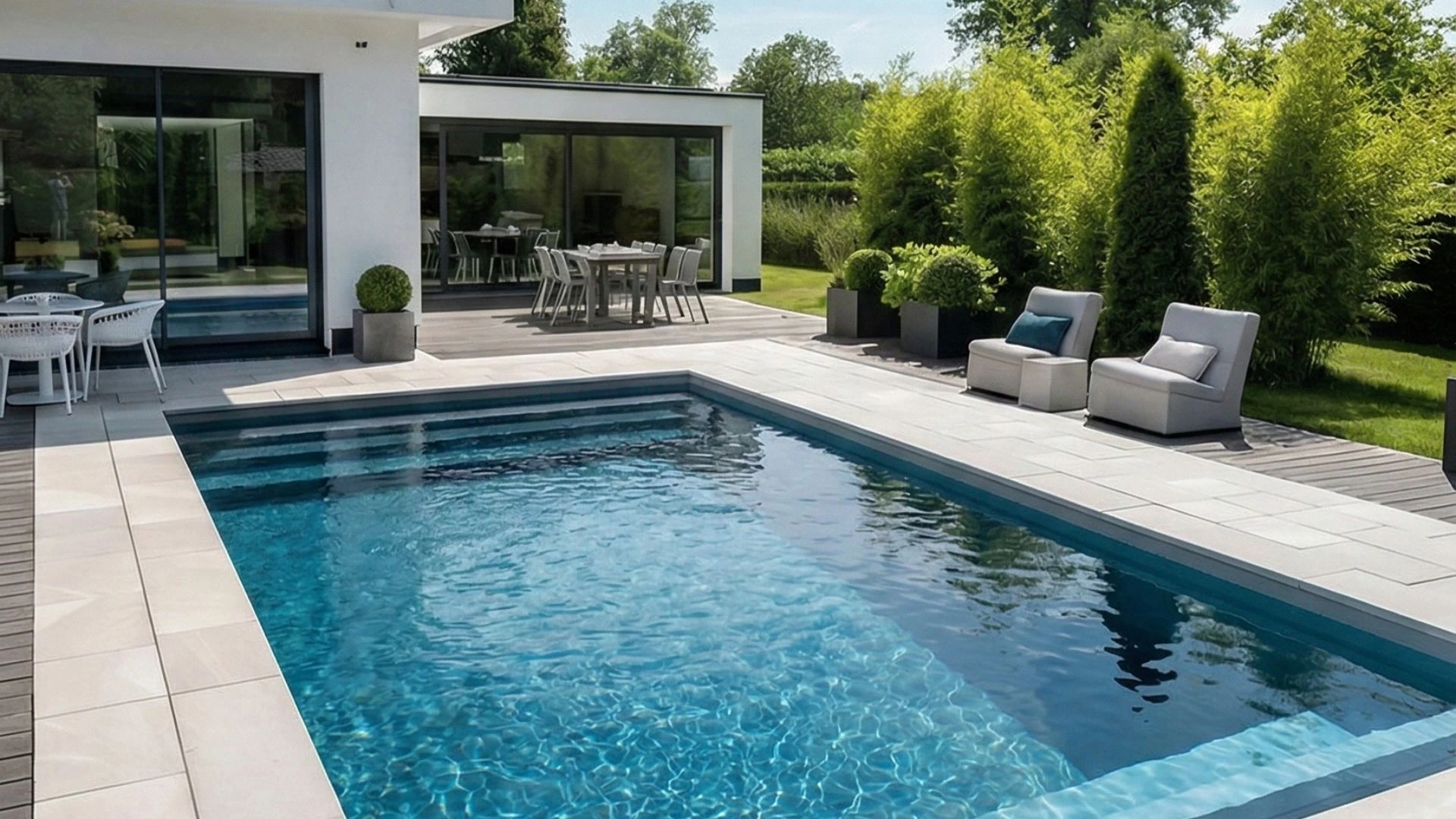
This article aims to turn the owner of an installation into an efficient manager of their own pool. You will learn how to make a professional transition from winter to summer, optimising the electrolysis technology of your salt chlorinator for 40 m3 pools to ensure healthy water with minimal energy use.
To start up a salt chlorinator for a 40 m3 pool successfully, you must ensure a pH between 7.2 and 7.4. It is essential to clean the pool thoroughly, balance alkalinity between 80 and 120 ppm and calibrate the pH/Redox probes of your BSPOOL unit after the winter to avoid reading errors and ensure automatic disinfection.
Contents
- Cleaning the pool and its surroundings
- Checking the water level
- In-depth analysis: chemical balance
- Is adjusting the pH the most critical step for your salt chlorinator for a 40 m3 pool?
- Checking the salt concentration
- Inspecting the electrolysis cell
- Servicing the filtration system
- Probe calibration (pH and Redox)
- The “stabiliser” factor (cyanuric acid)
- Operating test and programming of the salt chlorinator for a 40 m3 pool
- Conclusion
With the arrival of spring, the countdown to the swimming season begins. If you want to avoid last-minute surprises and ensure healthy water, April is the ideal month to service your salt chlorinator for a 40 m3 pool. A salt electrolysis system is smart and efficient, but to perform at 100% it needs the stage to be properly set.
Cleaning the pool and its surroundings
Before switching on the salt chlorinator for a 40 m3 pool, remove the winter cover and clean the walls and floor.
- Don’t forget to clean the skimmer and the overflow channel.
- Water free from leaves and organic debris drastically reduces the initial workload of your electrolysis unit.
Checking the water level
After the winter, it is normal for the level to have dropped due to evaporation or lack of use.
- Top up the pool to halfway up the skimmer opening.
- This is vital so the pump does not draw in air and the water flow through the cell of the salt chlorinator for a 40 m3 pool is constant.
In-depth analysis: chemical balance
To keep the salt chlorinator for a 40 m3 pool from overworking, don’t just measure chlorine.
- Alkalinity: It should be between 80 and 120 ppm to act as the pH shield.
- Calcium hardness: It is essential to control it to avoid scaling on the unit’s electrodes.
Is adjusting the pH the most critical step for your salt chlorinator for a 40 m3 pool?
Absolutely. Before the salt chlorinator for a 40 m3 pool starts producing, the pH must be between 7.2 and 7.4.
- If the pH is out of control, the chlorine generated by your BSPOOL unit will not disinfect.
- You will be wasting energy and shortening the lifespan of the cell in your salt chlorinator for a 40 m3 pool.
Checking the salt concentration
Measure the salt level in the water, as after the winter rains you will probably need to top it up so the salt chlorinator for a 40 m3 pool works within its optimal range.
- Remember: add the salt directly to the pool, never through the skimmer.
- Keep the electrolysis unit switched off while it dissolves to avoid conductivity peaks that affect the salt chlorinator for a 40 m3 pool.
Inspecting the electrolysis cell
Remove the cell and check for limescale on the titanium plates.
- If you see a white layer, clean it with a specific product (cell cleaner).
- A clean cell means efficient production in your salt chlorinator for a 40 m3 pool.
Servicing the filtration system
Good filtration helps the salt chlorinator for a 40 m3 pool keep the water clear with fewer operating hours.
- Clean the filter thoroughly (backwash and rinse if it is sand or glass).
- Check that the pressure gauge shows normal working pressure.
Probe calibration (pH and Redox)
This is where most users of a salt chlorinator for a 40 m3 pool go wrong.
- The probes of your BSPOOL unit are precision eyes, but after months of inactivity they may be out of calibration.
- Use calibration solutions to make sure the readings that manage your salt chlorinator for a 40 m3 pool are accurate.
The “stabiliser” factor (cyanuric acid)
In April the sun starts to get stronger and can degrade the chlorine generated by your salt chlorinator for a 40 m3 pool.
- Make sure you have between 30 and 50 ppm of stabiliser.
- Without it, the sun will “evaporate” the chlorine as fast as your salt chlorinator for a 40 m3 pool produces it.
Operating test and programming of the salt chlorinator for a 40 m3 pool
Switch on your BSPOOL unit and check that there are no low-flow or low-salt alarms.
- Adjust the filtration hours to the current water temperature.
- A useful rule for a salt chlorinator for a 40 m3 pool is: water temperature divided by 2.
Conclusion
Following this checklist not only guarantees a safe swim, but also extends the life of your salt chlorinator for a 40 m3 pool and all your BSPOOL salt electrolysis equipment. Prevention in April means savings in July.
Do you need to replace your cell or calibrate your probes for this summer? Explore our range of official spare parts and control systems on our website so your salt chlorinator for a 40 m3 pool performs at its best.
-
 4 min read
-
 3 min read
Maintenance
How to maintain your pool after the summer?
-
 3 min read
Maintenance
Summer is coming! How to prepare your pool
-
 3 min read
Maintenance
Is your pool protected from the rain?
-
 2 min read
Maintenance
Pool maintenance after the summer
-
 2 min read
Maintenance
Get your pool ready for summer
Got a question that none of our articles answers?
Our technical team replies in writing within 24 business hours, and the official service network covers all of Spain.